
How The Cost Of Living Crisis Affected UK Households (2026 Guide)
How does the UK Cost of Living crisis still impact food, energy, and housing costs? In 2022, when inflation reached its highest level due to many local and global causes, the prices of food, energy, and rents also increased. Then, the government raised interest rates in the following years to bring them down and support the UK’s economy. Inflation, in turn, gradually decreased to the current 3% rate, but costs show no signs of improvement.
All of these aspects made renting and buying a home tough, especially for lower-wage households. In these situations, Real Estate Agents London helps to find affordable housing that you can actually afford without worrying about high costs.
What Is The Cost Of Living Crisis
The period in which everyday living costs rise much faster than wages is termed a “Cost Of Living Crisis”. In 2021, people in the United Kingdom faced this crisis when prices of many essential goods increased much more rapidly than household incomes.
- UK inflation rate peaked at 11.1% in October 2022
- Rent, energy and food prices increased dramatically
- The Bank of England raised interest rates repeatedly in the following years to bring inflation down to the 2% target.
- Wages simply didn’t keep up, and affected low-income households

Causes of the Cost of Living Crisis
The UK’s cost-of-living crisis was not caused by only one component. Both global and local factors contributed to it, which still has an impact on budgets and finances, especially for low-income earners.
Global Causes
The world faced instability in various forms in the early 2020s, which became a major reason for the living crisis. One of the major causes is the COVID-19 pandemic, which creates severe social and economic disruption worldwide.
After Russia invaded Ukraine in February 2022, energy costs increased uncontrolled. In addition, the global chip shortage, energy crisis, and supply chains impacted economic stability in the following ways:
- More than 169 industries were affected, which increased the prices of oil, gas, and electricity.
- Manufacturers stopped producing and shipping due to safety precautions.
| The Bank of England’s governor said that around 80% of the crisis was due to these global factors. |
Local UK Factors
Several UK-specific causes, along with global ones, made the crisis even more challenging for households. Wage stagnation since 2008, for example, left many households with little savings. But younger demographics felt it the most in the 2010s.
Then, Brexit added further pressure to the economy because many foreign workers left due to labour shortages. Research from the London School of Economics found that it also increased food prices due to extra red tape on imports from Europe.
Other local factors that worsened the crisis include the 54% rise in the energy price cap, the increase in National Insurance and Council Tax, and the UK’s poor gas storage capacity.
| Global Factors | Local Factors (UK) |
| COVID-19 pandemic | Wage stagnation since 2008 |
| Global chip shortage | Brexit (labour shortages, higher food prices) |
| Global energy crisis | Energy price cap rise (54%) |
| Supply chain disruptions | Tax increases (National Insurance, Council Tax) |
| Russia-Ukraine war | Poor gas storage capacity |
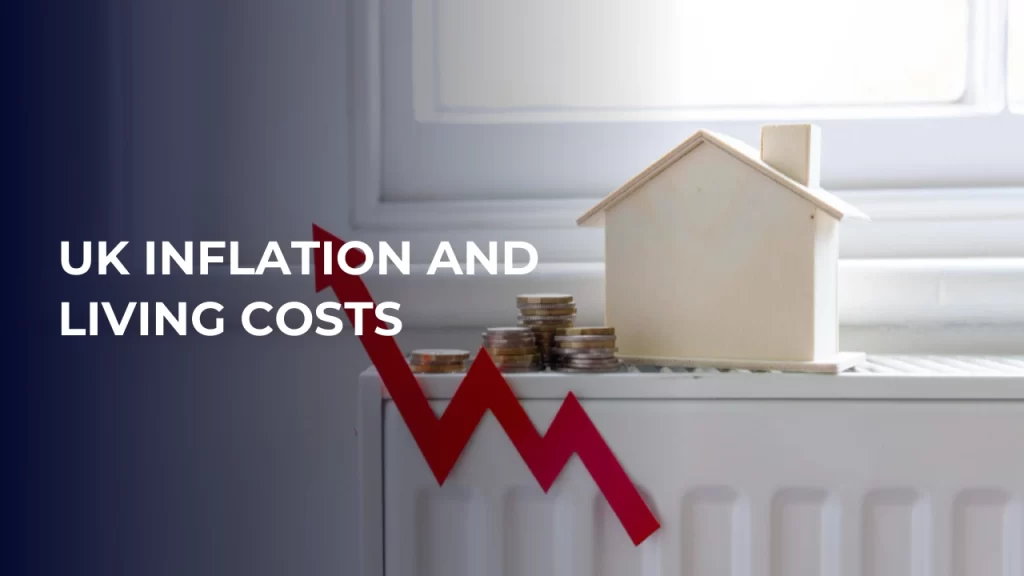
UK Inflation and Living Costs
In 2022, inflation rose to 11.1%, which was the highest level in over 40 years since the start of the crisis. In May 2024, inflation fell to 2.0%. Then it slightly increased to 3.2% in November 2025. Though the inflation rate has fallen since that time period, prices still remain higher.
Why Did Inflation Rise so Much?
The rapid inflation increase in 2021 and 2022 was caused mainly by international factors. Most of them were not under UK Government control. The major ones are:
- Global demand for goods and services
- Supply chain disruptions
- Soaring energy and fuel prices
Because the United Kingdom imports a large number of goods, including energy, these global pressures result in higher prices for UK consumers. By 2022 and 2023, prices not remain limited to just global goods. A big role is played by “Strong Wage Growth”, which raised prices in many areas of the domestic economy.
UK CPI Inflation Rate (2021-2026)
In early 2021, the rate was nearly zero, then increased rapidly in the year. The crisis high point was when it went to 11.5%. The rate has fallen slowly but remains above the Bank of England’s target rate 2%.
| Year | Jan | Feb | Mar | Apr | May | Jun | Jul | Aug | Sep | Oct | Nov | Dec | Annual Avg |
| 2026 | 3.01 | – | – | – | – | – | – | – | – | – | – | – | – |
| 2025 | 2.98 | 2.84 | 2.59 | 3.53 | 3.36 | 3.58 | 3.83 | 3.79 | 3.78 | 3.56 | 3.25 | 3.37 | 3.37 |
| 2024 | 3.98 | 3.41 | 3.23 | 2.33 | 1.99 | 1.98 | 2.23 | 2.22 | 1.68 | 2.28 | 2.62 | 2.5 | 2.53 |
| 2023 | 10.05 | 10.42 | 10.06 | 8.66 | 8.68 | 7.95 | 6.83 | 6.66 | 6.65 | 4.6 | 3.94 | 3.99 | 7.3 |
| 2022 | 5.46 | 6.18 | 7.02 | 9.01 | 9.08 | 9.41 | 10.1 | 9.87 | 10.1 | 11.05 | 10.67 | 10.53 | 9.07 |
| 2021 | 0.7 | 0.41 | 0.71 | 1.53 | 2.12 | 2.51 | 2.04 | 3.2 | 3.08 | 4.21 | 5.13 | 5.39 | 2.59 |
How Can I Reduce My Monthly Grocery Bills During The Cost Of Living Crisis?
Food prices increased during the crisis, as around 44% of Britons still say they have struggled to pay their food bills in the last three months. Food is undoubtedly a major part of household expenditures. But using these simple tips, you can spend less and save money on your grocery bill.
Switch Supermarkets:
People mostly shop at the same supermarket out of habit. But prices differ much from store to store. It’s better to take your time and compare prices between different supermarkets for the same items.
Cut down on Non-Essential Food Items:
You should cut back on things that you don’t really need because minor routine changes can save money. For example, instead of buying lunch at work, bring it from home. healthy and cheaper
Take Advantage of Deals and Rewards:
Most supermarkets offer loyalty cards and weekly deals. These are free to use and help to save money over time.

Is The Cost Of Living Crisis Coming To An End?
Even now, the living crisis is not over for most people. The Office for Budget Responsibility reported that household incomes are not expected to recover to their 2021 levels until 2027 or 2028. Not only this, 54% of Britons named this “cost of living” as the top national concern in January 2026.
On the other hand, 61% of adults reported that their cost of living expenses had increased in November 2025, compared to the previous month. Among them, 95% sees food as the most expensive, while 68% think it’s because gas and electricity bills are increasing in price.
Conclusion
Due to the UK Cost of Living Crisis, food, energy, and housing costs are all still higher than before, even though inflation slowly fallen near the Bank of England’s target rate. These rising prices made saving up a large deposit to buy or invest in a property pretty difficult.
Many people now face the risk of being pushed into homelessness. Even managing a property single-handedly to earn rental income is not easy in today’s market. That is why landlords rely on property management services to manage costs and protect their investments.
FAQs
In more than half of British neighbourhoods, renters are paying an average of at least £1,000 a month for a new tenancy. Just 23% of local authority areas had average rent above £1,000 in 2020. However, after five years, that percentage increased to 52%. Over time, wages improved, but many tenants say renting has become unaffordable.
Yes, £3,000 a month is generally enough for a single person to live comfortably in the UK. With careful budgeting, it can easily cover housing, transport, food, utilities and bills.
Most economists think that it is possible to avoid a recession in 2026. However, slow economic growth, high cost of living, and inflation pressure still affect households, especially low-income earners.
The impact of Brexit is mixed. Some sectors face higher costs while others have new, better opportunities. However, overall economic growth is slower than expected.
No, the UK economy is not going to collapse. Growth may be slow, and households may need to face financial difficulties. But complete economic collapse is not going to happen, at least now.
The money you need for a quality of life in the UK depends on the city and your lifestyle. Some cities are more expensive than others. London, for example, requires a higher salary of at least 35 to 45,000 pounds.
Our Agents

Adil Saleem

Qaiser Masood

Rizwan Ashraf
Leave a Reply