
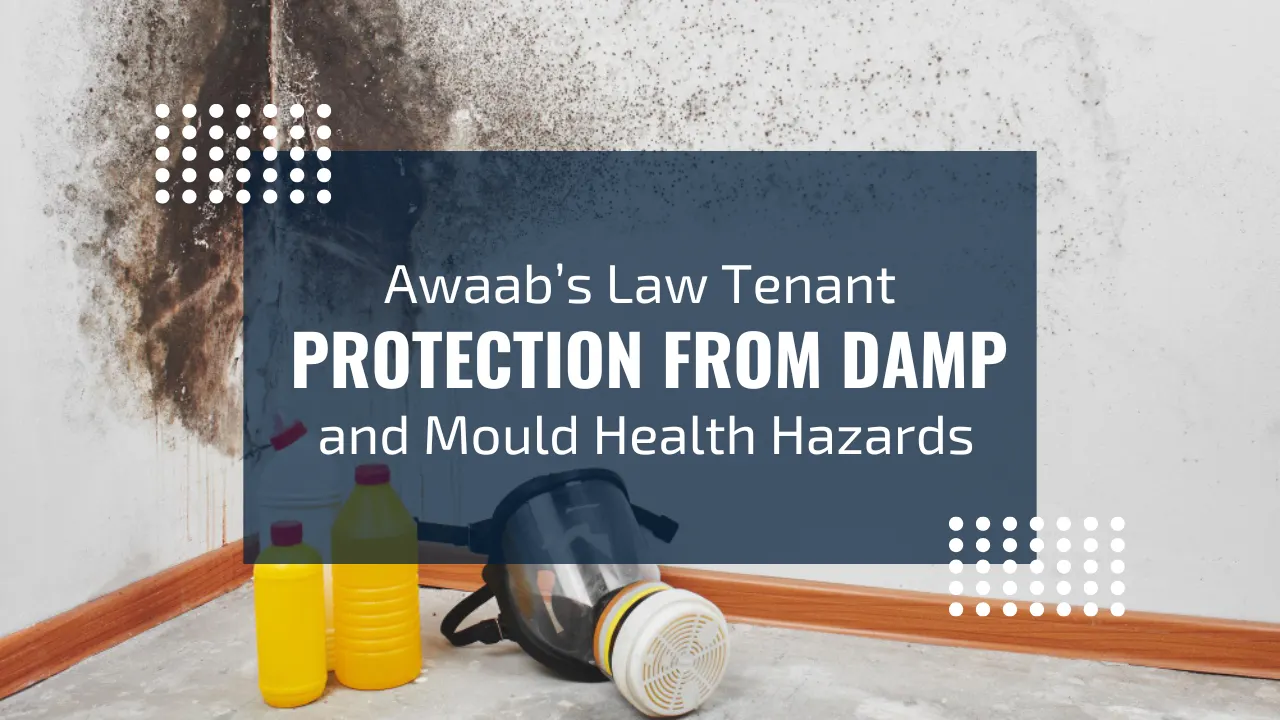
Awaab’s Law: Tenant Protection From Damp and Mould Health Hazards
Can tenants really feel safe in social housing after the tragic death of Awaab Ishak? Yes, because Awaab’s law is not just a legal requirement; in fact, it is a matter of protecting residents’ health, safety, and lives.
This sets a new standard of accountability for tenant protection, and Real Estate Agents London Company is here to help you meet it. We offer reliable tenant management services that handle all tasks and rental procedures, ensuring the property runs smoothly and meets all legal requirements.

What Is Awaab’s Law?
Awaab’s Law, a new housing legislation introduced by the UK Government on October 27, 2025, aims to improve social housing conditions and protect tenants from health risks and poor living conditions. For example, prolonged exposure to damp and mould can cause serious health problems, including skin infections, asthma and respiratory diseases, especially in children, the elderly and people with existing health issues.
Overall, this is a step towards a goal that every resident feels protected and safe in their rental homes and meets Decent Homes Standards, as discussed further in the Renter’s Rights Bill.
Why The UK Government Introduced Awaab’s Law in Social Housing
The law was named after Awaab Ishak, a 2-year-old boy who tragically died in 2020 from prolonged mould exposure in his social housing flat. A post-mortem examination showed fungal spores in his lungs. His death highlights the need for urgent attention to the poor housing conditions.
That’s why the government introduced this law to prevent such incidents and protect tenants’ health and wellbeing. This is now enshrined in the Social Housing Act 2023.

To Whom Does Awaab Ishak Law Apply?
This law applies to all registered social housing landlords in England. This includes local authorities, housing associations, and other registered social housing providers.
Does Awaab’s Law Apply to Private Landlords?
Currently, private landlords are not covered by this law. However, they remain bound by the Housing Health and Safety Rating System and other fitness standards.
Implementation Phases of Awaab Ishak Law
Phase 1 of this law came into force last year, covering serious mould and damp issues. The remaining two phases will address other health-related hazards after the formal consultation process.
| Phase | Implementation Date | Hazards Covered |
| Phase 1 | 27 October 2025 | Damp and mould, and all emergency hazards |
| Phase 2 | 2026 | Excess cold and excess heat, falls, structural collapse and explosions, fire hazards, electrical hazards, domestic and personal hygiene, food safety |
| Phase 3 | 2027 | All remaining HHSRS hazards (excluding overcrowding) |
Issues Covered Under Awaab’s Law
This law focuses on the two major categories of hazards in social housing:
Significant Hazards
These include all health and safety risks reported by residents. Landlords must investigate and fix these issues within the set timeframes. For Example:
- Damp and Mould
- Excess Cold and Heat
- Fire and Electrical Safety Hazards
- Risks of Falls and Structural Collapse
- Food Safety Risks
- Domestic and Personal Hygienic Hazards
Emergency Hazards
Issues that pose immediate risks to tenants’ health and safety. So, it’s the homeowners’ responsibility to address these high-risk situations as a top priority within 24 hours. For Example,
- Severe Damp And Mould
- Gas or Carbon Monoxide Leaks
- Broken Boilers
- Total Loss of Water Supply
- Broken External Doors or Windows that present a risk to home security
- Structural Defects or Disrepair
- Electrical Hazards such as Exposed Wiring
Awaab’s Law Timescale or Requirements
This new legal process places a responsibility on the social landlords to investigate, act, and repair life-threatening issues quickly within strict timeframes. Failure to do so can result in enforcement action by the Regulator of Social Housing or the Housing Ombudsman.
| What Landlords Must Do | Timeframe |
| Check for hazards (like damp and mould) | Within 10 working days |
| Send a written summary to the resident | Within 3 working days of the check |
| Fix serious hazards | Within 5 working days (temporary fixes if needed) |
| Do full repair work | Within 12 weeks for extra work, a reasonable time for full repairs |
| Handle emergencies | Within 24 hours |
| Provide alternative housing if the hazard can’t be fixed | Immediately, at the landlord’s expense |
| Keep records of actions and communications | Always |
| Cover more hazards | 2026: cold/heat, falls, fire, electrical, hygiene, food safety; 2027: all remaining HHSRS hazards except overcrowding |

Landlord’s Obligations Under UK Social Housing Law
Under this law, landlords must:
- Investigate reported health hazards within a fixed number of days after being informed.
- After the investigation, complete repair work within a specific period of time.
- Complete repairs within a legally defined timeframe, unless there are exceptional situations.
- Provide a written statement to the tenant.
- Ensure that Property Management teams (overseeing all tenant and rental-related tasks on your behalf) or contractors respond quickly.
- Communicate clearly with tenants about reporting issues and timescales for action.
Types of Investigations Under Social Housing Law
These are four types of investigations every landlord must know and conduct to comply with legal rules and regulations.
| Investigation Type | Purpose | Timeframe | Notes |
| Standard | Check if the hazard is significant or an emergency, and identify the required safety work | 10 working days | Can be remote or in-person; restarts if hazard changes |
| Renewed | In-person check requested by tenant after remote investigation | 10 working days | Timeline restarts; not needed if work has already started |
| Emergency | For hazards posing an immediate risk to health/safety | 24 hours | Can be remote or in-person; starts immediately if an emergency is suspected |
| Further | If previous investigations can’t fully find the cause or solution | As soon as possible | Must do urgent safety work even while investigating |

How to Prepare for Awaab’s Law
- Stay up to date with the consultation process and implementation phases.
- Review and understand the response procedure for damp and mould.
- Ensure your teams or manager are fully trained, just like Block Management services, which can handle all day-to-day operations perfectly, reduce your headache and share responsibilities.
Conclusion
The Awaab’s Law is not just a legal change, but a recent shift in social housing standards that confirms governments’ dedication to the safety of the UK rental sector. It’s an initiative to protect tenant health and rebuild trust in social housing by raising decent living standards. Landlords are now legally obliged to respond to all life-threatening hazards, such as damp and mould, as soon as possible.
Frequently Asked Questions
In the UK, a 3-bedroom rental property can accommodate around 6 people, 2 residents per bedroom. However, the actual limits can vary depending on local council rules, room size, and property type (HMO).
Yes, residents can challenge a rent increase if it is unreasonable, not properly notified, or if it violates legal procedures. In such cases, they can apply to the First-Tier Tribunal to review the rent rise. However, if they refuse to pay a reasonable rent increase, landlords can take action, such as ending the tenancy agreement or evicting them.
Awaab is an Arabic boy’s name that means repentance, humility, and one who turns back to God.
Anything dangerous to tenants’ health and safety that needs quick fixing is considered an emergency hazard.
It only came into force in England on 27 October 2025, protecting all social housing residents from issues like damp and mould. But the government is thinking of applying it to other regions as well.
Our Agents

Adil Saleem

Qaiser Masood

Rizwan Ashraf
2 responses to “Awaab’s Law: Tenant Protection From Damp and Mould Health Hazards”
[…] Awaab’s Law came into force for social housing in October 2025 following the death of two-year-old Awaab Ishak, who died in 2020 after prolonged exposure to mould in his Rochdale flat. For social landlords, it currently requires: […]
[…] LawFollowing the death of two-year-old Awaab Ishak from a prolonged black mould exposure, Awaab’s Law has set fixed time frames within which social housing landlords are obligated to respond to […]
Leave a Reply